

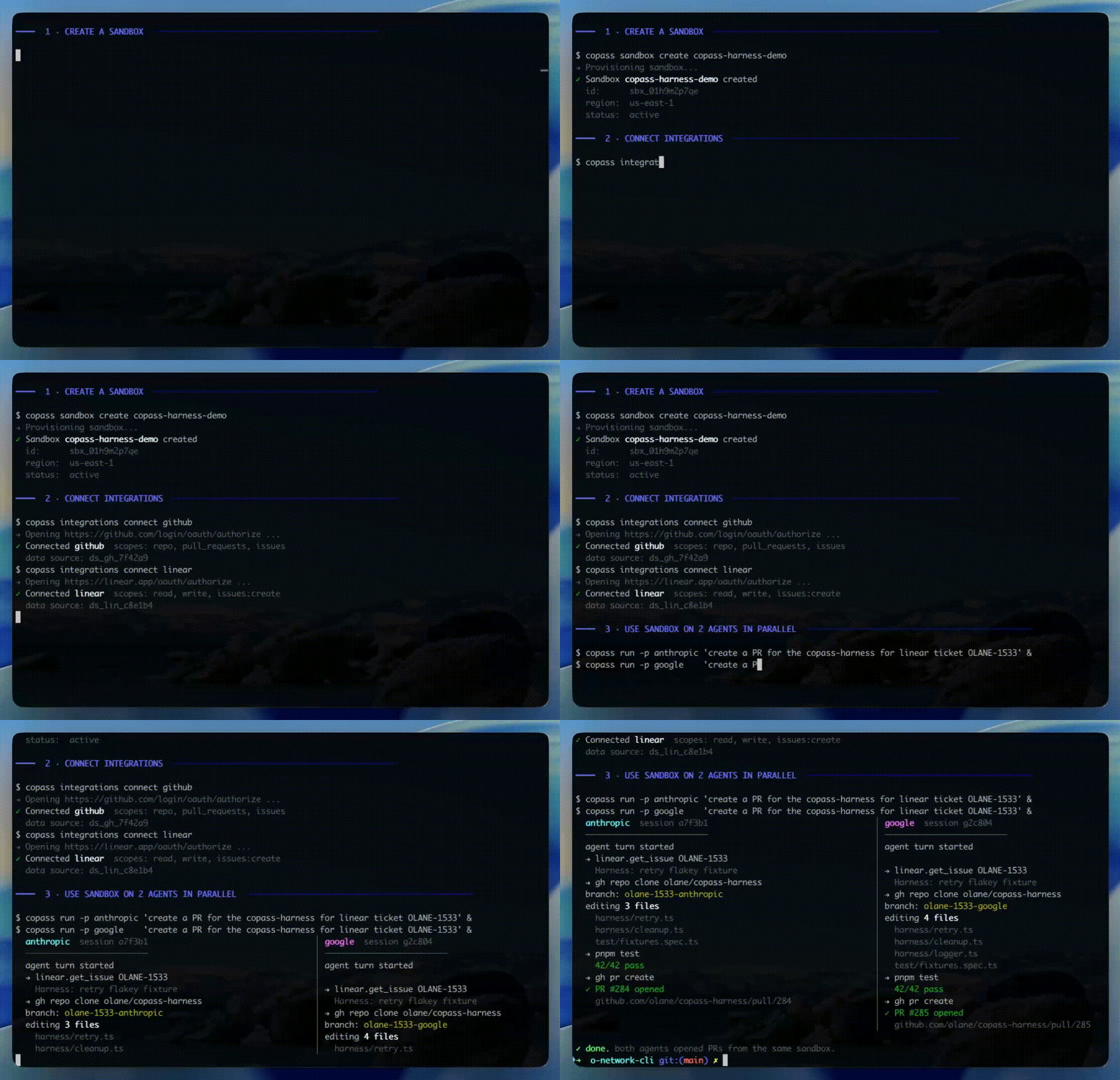
Execute your first agent call in minutes
Pick a use case on the left. Every call uses the Agent Router SDK. Flip a provider flag to swap Claude and Gemini.The flow
Create a sandbox
A sandbox is your app’s tenancy — its vault, its keys, its quotas. Sandboxes are free; spin up as many as you want (one per app, per environment, per customer, per experiment).More in Multi-tenancy.
Add data sources
A data source is anything feeding content in — a folder of docs, an OAuth’d integration (GitHub, Slack, Notion, …), or a custom firehose you push to directly.Connections live in the sandbox forever and light up as tools for every agent run. More in Integrations.
Run agents in the sandbox
The Agent Router is the default runtime. Hand it a provider and a prompt; it streams back provider-neutral events. Swap providers on a per-call flag — memory, tools, and connections stay.More in Agent Router.
Core primitives
| Concept | What it is |
|---|---|
| Sandbox | Your app’s tenancy. Owns the vault prefix, keys, and quotas. Free to create. |
| Data source | The unit of attribution. Every ingested byte is tagged to one; integrations land as data sources too. |
| End user | A human inside your sandbox, identified by endUserId. Isolates their connections and memory. |
| Context Window | The agent’s conversation memory — an ephemeral data source in the sandbox, shared across providers. |
| Agent backend | The runtime (anthropic, google, …) that executes a turn. Swappable per call. |
Get started in 60 seconds
Next steps
- Concierge — the default way to build with Copass. Skip the CLI / SDK dance; describe what you want.
- Quickstart — the minimum viable ingest → retrieve loop, manually.
- Cookbooks — multi-integration recipes (decision archaeology, cross-repo feature, standup killer, customer health radar, post-mortem draft).
- Agent Router — run a hosted agent with OAuth’d integrations.
- Multi-tenancy — how one sandbox holds many end users.
- API Reference — the raw HTTP surface.